While I’ve done it plenty of times, using my starter past its peak is something I stopped doing when I began paying close attention to its health and maintenance. When a starter falls, that means either enough acid has accumulated to suppress microbial activity or that the CO2 produced by microorganisms has exceeded what the gluten structure can support. While the latter has minimal effects on bread dough, the former can be detrimental. This experiment was meant to prove a point about fermentation; nevertheless, I ended up learning some things about starter resilience that I am excited to share.
The Hypothesis
My original intent was to compare two loaves of bread: one made from a very acidic starter and the other from a well-balanced starter. Due to the overwhelming number of variables, this proved very difficult!
First, there are two types of acid—lactic and acetic—each with distinct effects on bread dough and fermentation. Second, because my starter is already well-balanced, I found it impossible to unbalance it with just one or two feedings. (I wasn’t about to waste heaps of flour just to intentionally ruin my starter!)
Therefore, I fed my healthy, well-maintained starter once, let it acidify, and observed how it performed in bread dough.
My thinking was that if I accumulated enough lactic acid in my sourdough starter, it would break down the dough too soon. This would force me to cut fermentation short or risk a dough that appeared ‘over-proofed’—not truly over-proofed, but too weak to maintain its structure—becoming sticky and hard to manage over time.
In theory, this would result in a loaf with poor oven spring and a dense, closed crumb.
The Experiment (Plus Video)
This experiment revolved around the difference in the sourdough starters. Both were off-shoots of my well-maintained starter; however, one was made to become very acidic while the other was maintained and used as per usual. Let’s compare:
Both Starters
Feeding Ratio
Both starters were fed a 1:5:6 ratio (one part starter, five parts water, six parts flour). The approximate hydration was 85%. Specifically, this was 10 g active, well-maintained starter, 50 g filtered water, and 60 g flour.
Temperature
Both starters were maintained at an ambient temperature of 73-75 F (23-24 C) for the duration of their fermentation, except in the last four hours of fermentation where they were maintained at an ambient temperature of 70-72 F (21-22 C).
The Acidic Starter
Flour Choice
This starter was fed with Sunrise Flour Mill Heritage Bread Blend Flour.
I do not recommend using this flour for bread dough. Its gluten quality is poor, which leads to weak fermentation. Of all the bread flours I’ve tried, this ranks near the bottom. No matter what I do, I cannot get it to produce the light, airy bread I strive for in sourdough.
Despite its low gluten quality, this flour offers some advantages for acidifying a starter. It is freshly milled and has a lower extraction percentage, meaning more bran and germ remain in the flour blend. Fresh milling increases enzymatic activity, speeding up fermentation, while more bran and germ enhance ‘buffering capacity’—essentially, greater acidity. I hoped these attributes would boost acidity in my starter more quickly, with just one feeding.
Fermentation
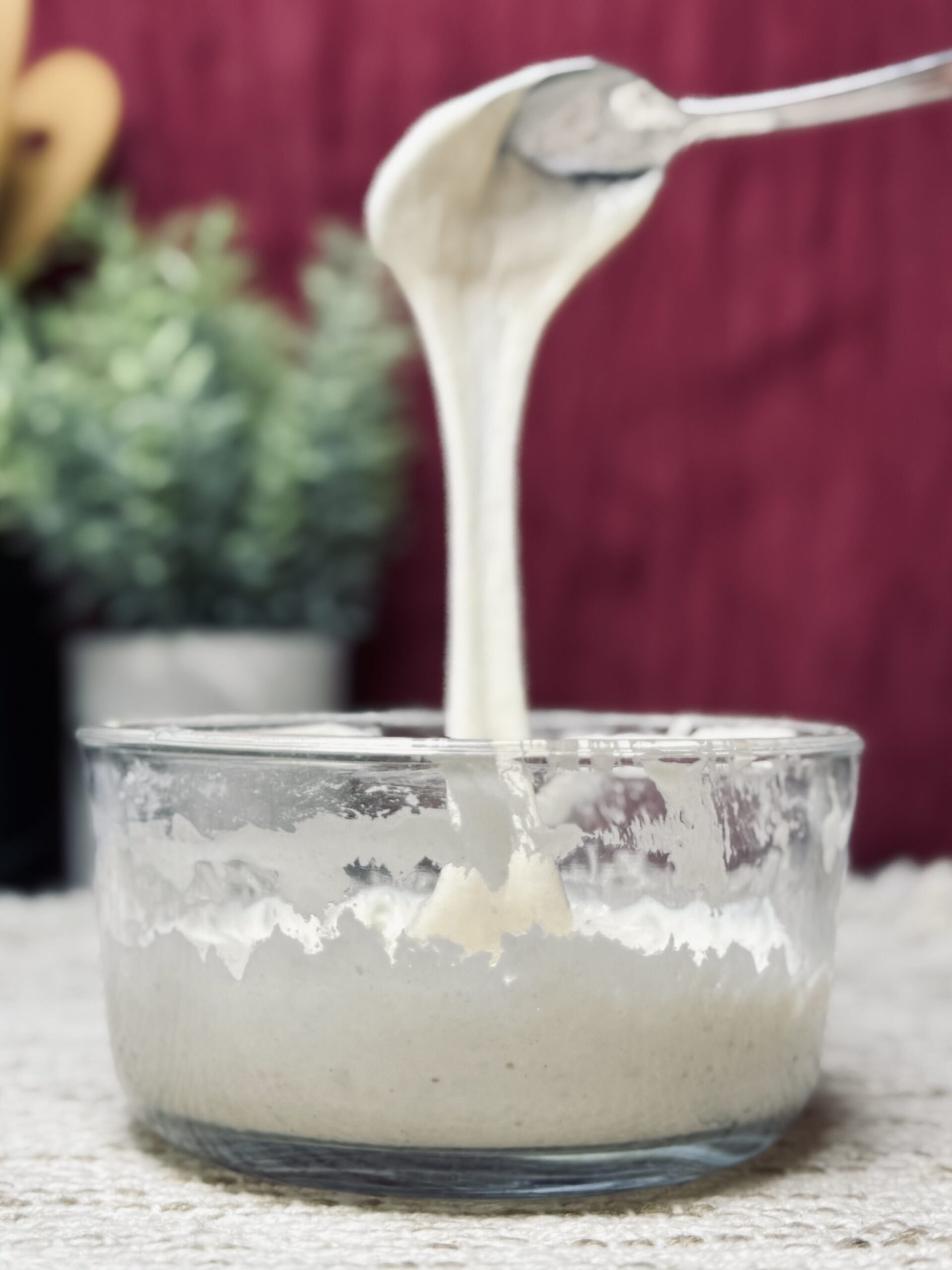
This starter was fermented for 27 hours in total before being incorporated into bread dough. The first 24 hours were fermented at an ambient temperature of 73-75 F (23-24 C) in my Brod & Taylor Sourdough Home. The starter was given one “stir” (set of stretch-and-folds) at 12 hours, and another at 24 hours. After 24 hours, the starter was removed from the Brod & Taylor Sourdough Home and left to rest at room temperature (70-72 F; 21-22 C) next to its premixed bread dough. The starter was added to the dough at 27 hours old. The pH was 3.64.
By the end of fermentation, the starter was very loose, without form. The starter was very clearly past peak and had lots of little bubbles, but no soapy bubbles (which are an indicator or too much lactic acid). It poured and spread very easily. See video for visuals.
The Control
Flour Choice
This starter was fed with King Arthur Bread Flour.
This flour is just the opposite of Sunrise: strong gluten, aged, higher extraction. It does not ferment quite as rapidly or accumulate acidity in the same way. This is the flour I normally use to feed my starter.
Fermentation
This starter was fermented for 15 hours in total before being incorporated into bread dough. The first 12 hours were fermented at an ambient temperature of 73-75 F (23-24 C) in my Brod & Taylor Sourdough Home. The starter was given one “stir” (set of stretch-and-folds) at 12 hours. At this point, the starter was removed from the Brod & Taylor Sourdough Home and left to rest at room temperature (70-72 F; 21-22 C) next to its premixed bread dough. The starter was added to the dough at 15 hours old. The pH was 3.80.
Everything about this starter was normal and healthy. By the time the starter was stirred at 12 hours, it had tripled in size. By the time it was added to the bread dough, three hours later, it had more than doubled in size again. It still had all of its structure, very strong. See video for visuals.
The Dough
Both bread doughs were made the exact same way. Rather than cut fermentation short for the acidic starter (for fear of the dough losing structure), I decided to keep fermentation the same in order to directly compare the outcomes. My timing was right on point; everything I did was to the exact minute I planned on doing it. You can watch the video to see the entire process step-by-step. The process I used for both doughs is as follows:
- Prepare starters as described above.
- Premix bread dough (350 g Bob’s Red Mill Artisan Bread Flour, 6 g Redmond Real Salt, 300 g warm water from the tap) and let it rest in my Brod & Taylor Folding Proofer set to 73 F (23 C; ambient temperature 73-75 F [23-24 C]) for three hours.
- After three hours, smear 75 g sourdough starter over the top of the premixed bread dough and layer it in with as many coil folds as possible. Rest for 30 minutes.
- Perform one lamination. The dough is stretched out, without tearing, on the counter top, then folded up and transferred to a rectangular proofing dish. Rest one hour.
- Coil fold the dough. This ended up being five folds for each dough. Rest two hours.
- Coil fold the dough. This ended up being three folds for each dough. Rest for the remainder of bulk fermentation.
- After 7 1/2 total hours of bulk fermentation (four hours after the last fold), shape the dough using a gentle shape method. Fold the left and right sides inward, then roll the dough from the top downward. Refrigerate overnight (13 hours for these doughs).
- Score and bake at 500 F (260 C) in Challenger Bread Pan for 20 minutes with the lid on, then at 450 F (230 C) for 15 minutes with the lid off.
- Cool completely before slicing.
The Results
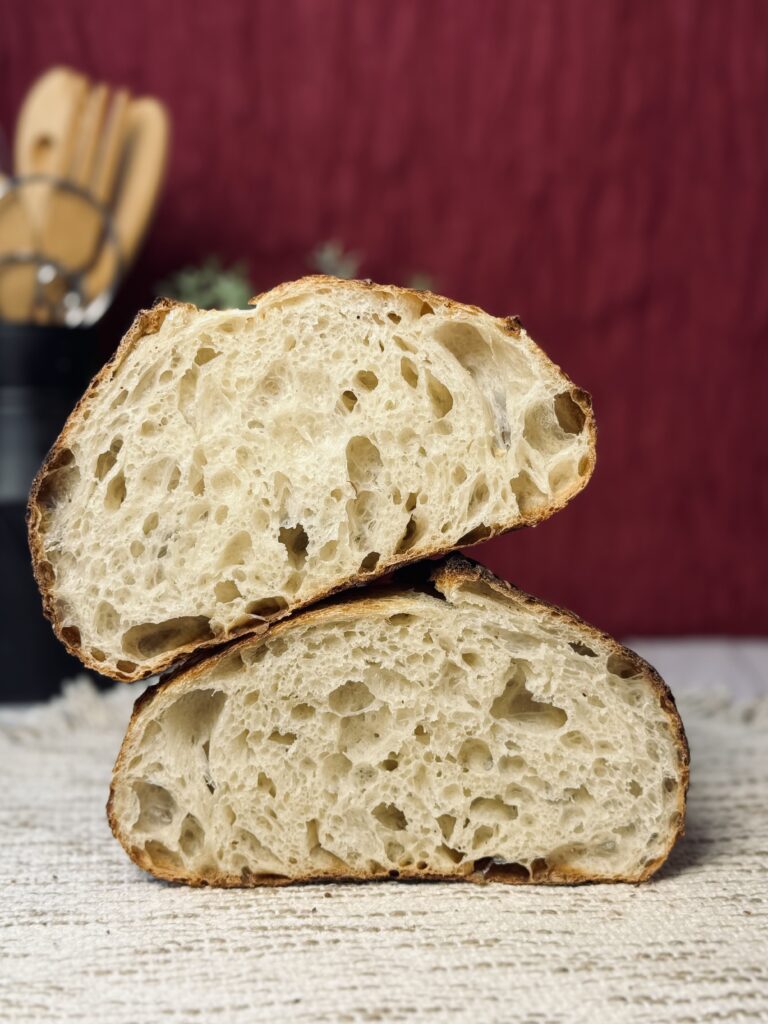
Similarities
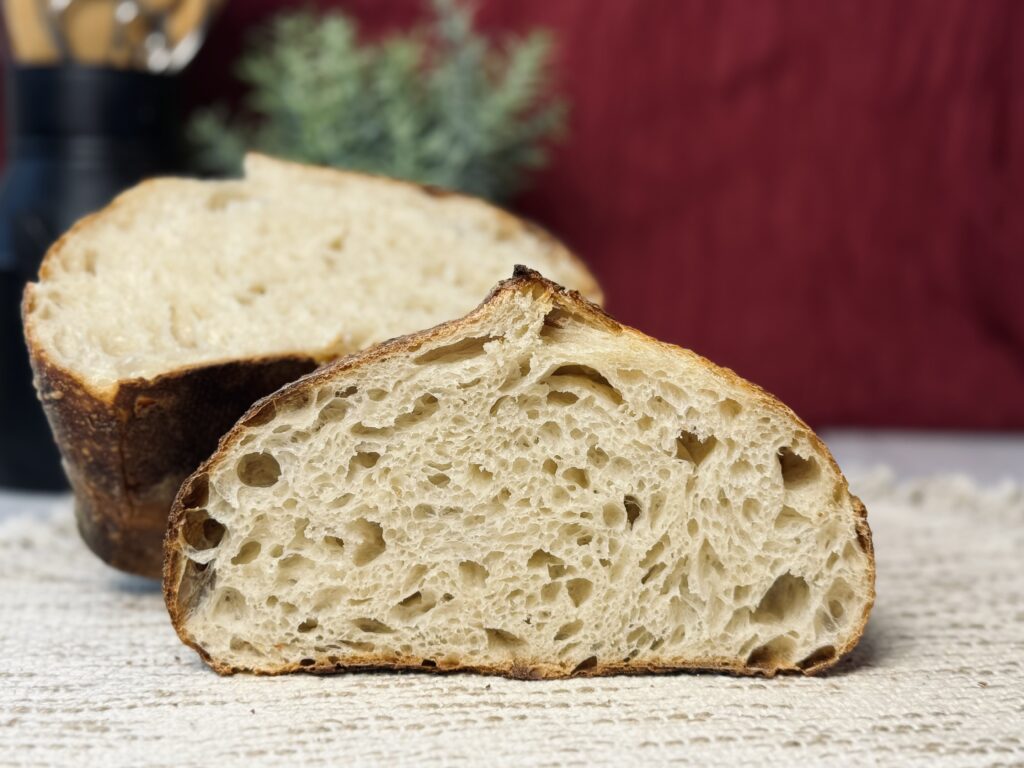
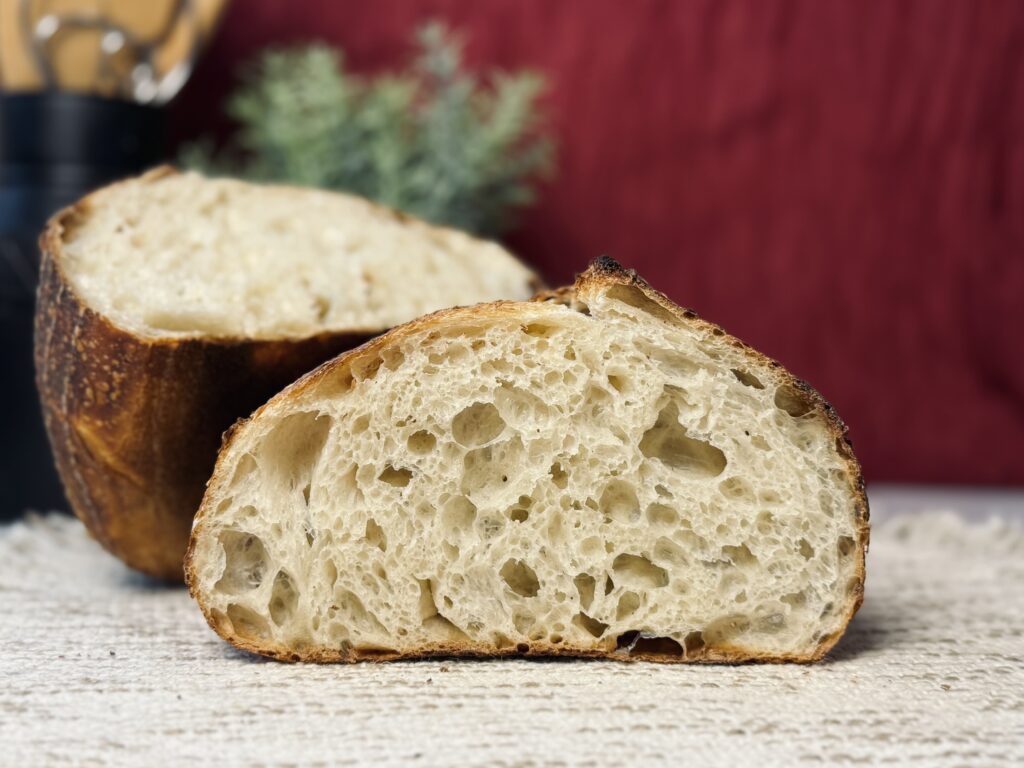
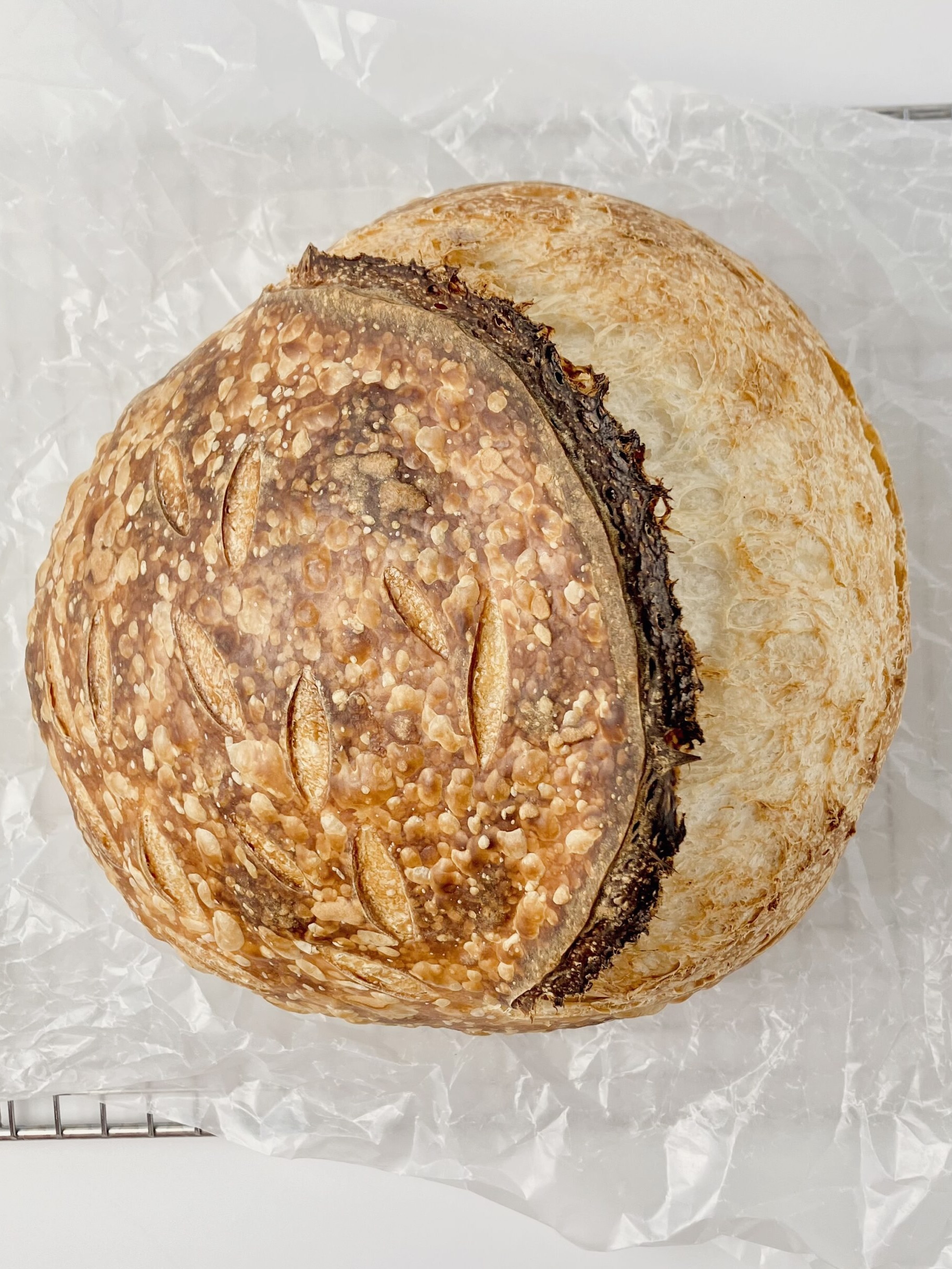
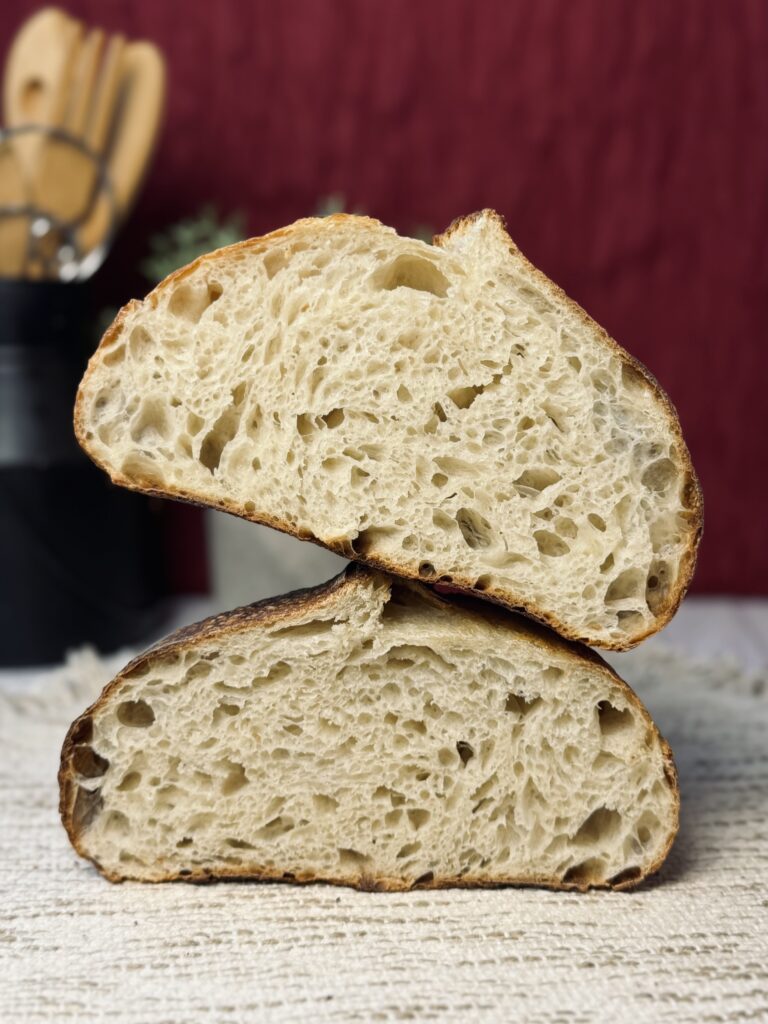
I was shocked that both of these were great loaves with many similarities, despite the drastic difference in the state of the starter.
- Both loaves had a fabulous oven spring.
- Both loaves had a well defined score.
- Both loaves had a thin, crispy crust.
- Both loaves had an open crumb.
- Both loaves had the same texture, which was airy but not overly-so.
Differences
The main differences came from the effects of the excess lactic acid. Lactic acid increases the speed at which proteases (an enzyme) degrade dough, meaning that it was causing my dough to “over-proof” faster than it would without it, effecting how far fermentation could be pushed.
- The dough for the acidic loaf was slightly stickier.
- The acidic loaf had a more even crumb, due to the extra lactic acid.
- The acidic loaf had mild/yogurt sour notes, due to the extra lactic acid.
- The score on the acidic loaf “popped” more in the oven, likely due to the extensibility gained from the extra lactic acid.
The Conclusion
Had my starter continually accumulated lactic acid over many repeated feedings, the results likely would have been far more dramatic. However, using a well-maintained starter past its peak for bread dough turned out to be just fine.
I was still able to ferment this dough as usual, without ruining the loaf. While the excess lactic acid further degraded the dough, it resulted in an open, even crumb rather than an open, irregular one—something many bakers find desirable. Because the dough still fermented fully without losing air, the texture remained unaffected, resulting in a light and airy loaf.
The loaf also had a flavor that some bakers actively seek. Lactic acid imparts mild, yogurt-like notes, in contrast to the sharp, cheddar-like notes of acetic acid—flavors some bakers love. While I prefer the balanced flavor of the control loaf, if you’re seeking the flavor profile of lactic acid, this could be a good strategy for achieving it.
Overall, using my starter past its peak did no harm and may have even enhanced traits that some bakers find desirable. Take this experiment as it is and use it however you see fit!